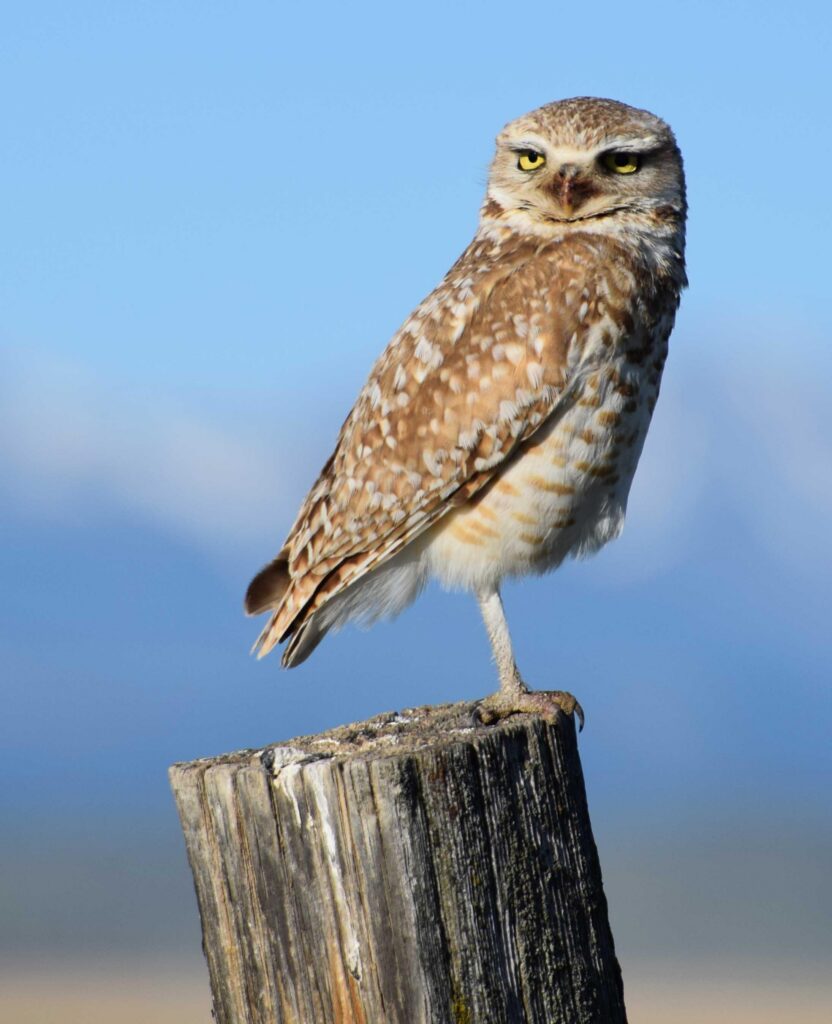
The western burrowing owl is North America’s only owl that lives underground. They typically use ground squirrel burrows but may also occupy larger burrows made by mammals such as foxes or badgers. I’ve been fortunate to watch burrowing owls during their recent nesting season in open fields near Three Forks, Montana. Not only are the owls and their owlets fascinating to watch, I’m also interested in their burrows. My interest stems from work that colleagues and I are doing on Eocene fossil burrows (about 39-36 million years in age) located north of Dillon. We are still wrestling with the genesis of the fossil burrows, but it does help to look at a variety of present-day burrows and their associated inhabitants.
But – back to burrowing owls near Three Forks, Montana. The birds occupy ground squirrel burrows that are dug into Tertiary strata. The Tertiary rocks in the general burrow area are relatively easy to excavate because they consist mainly of mudstone to fine sandstone. As a geological note for this area, previous work by Robinson and Barnett (1963; see reference below) gives an age of approximately 34-36 million years for these rocks, based on contained fossil mammals.
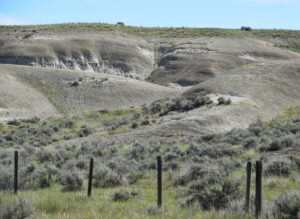
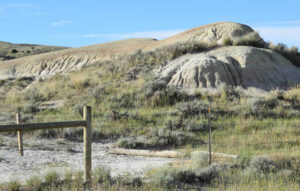
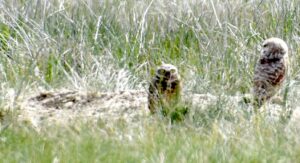
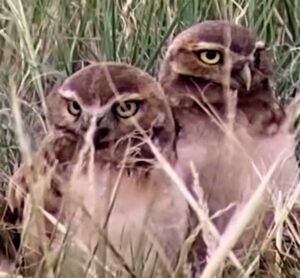
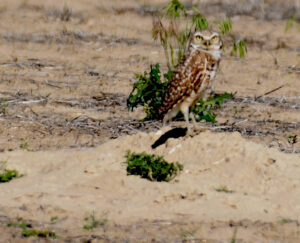
The abundance of ground squirrel and other mammal burrows in this part of southwest Montana shows that the soft Tertiary rocks are well suited for excavation. Not only are there several breeding pairs of burrowing owls in these open fields, the owlet fledglings can now be seen perching on abandoned burrows at some distance from their original burrow site. Although mammals rather than birds most likely made and occupied our Eocene fossil burrows, observing any living creature’s relationship to its burrow is always instructive. And – the burrowing owl families are really fun to watch!
Reference: Robinson, G.D., and Barnett, H.F., 1963, Geology of the Three Forks quadrangle, Montana, with sections on petrography of igneous rocks: U.S. Geological Survey Professional Paper 370, iv, 143 p.